
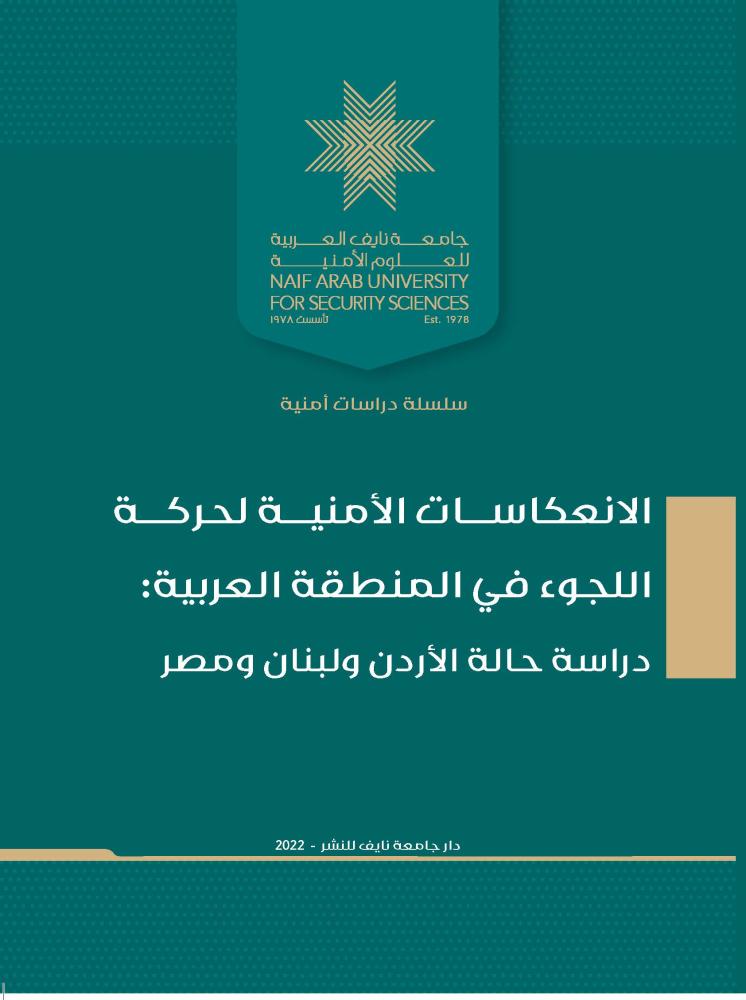

Security Repercussions of Asylum in the Arab Region: Jordan, Lebanon, and Egypt as a Case Study

Security Studies Series

100

Category: Security Studies Series, Migration and Border Security

Publication Year: 2022

Language: Arabic

Publisher: Naif University Press

Author(s): Ahmed Mousa Badawi, Sahar Aref Mukhaymar, Dolly Kamal El-Sarraf, Ibrahim Seif Menshawi


This report aims to study the repercussions of the refugee crisis in the Arab Region by carefully examining Jordan, Lebanon, and Egypt as cases of study. In doing so, it analyzes the international and national databases by casting light on the condition of refugees worldwide starting from 2010. It then moves to examine the condition of refugees in Jordan, Lebanon, and Egypt as well as the security repercussions and recommendations that should be taken into account by the decision-makers and executive officials when addressing the security problems resulting from the refugee. The results are interpreted in the light of a new concept used for the first time in closely related reports, which is the concept of integrative human security, it is considered an amendment to the concept of human security adopted by the United Nations in 1994, by making all components of achieving human security linked to each other by the integrative circumstance.

The report reaches the following conclusions: There is a significant increase in refugee rates in the world, while the United Nations High Commissioner for Refugees has extended its protection only to a third of the refugees in the world. The Arab Region has truly faced big challenges related to refugees from the very beginning of the Palestinian refugee crisis in 1948 until the Syrian refugee crisis in 2011. It is actually considered one of those regions of the world that are influenced much by refugees along with all its security repercussions. The report also concluded that state institutions in Jordan, Lebanon, and Egypt face immense pressures due to such situations, stressing meanwhile that the condition of both Lebanon and Jordan, in order, is more critical than that of Egypt, and all the response plans to the refugee crisis, which is being implemented in the three countries in collaboration with the UN agencies, donors, and NGOs, come to their end without the third-party organizations meeting their total obligations.

The report came up with a number of recommendations, as follows:

(1) The necessity of coordinating Arab efforts - under the auspices of the League of Arab States - in order to develop strategies and design plans that urge the international community to fulfill its obligations, and to provide the necessary support for the three Arab countries, stressing meanwhile on the importance of supporting the hosting local communities as well as giving hand to the refugees gatherings therein; (2) establishing a joint database on the demographic code-relating characteristics of all the registered/unregistered refugees in the hosting Arab countries; (3) establishing an academic center to study the future of the refugee situations in the Arab region, with its mission be restricted to be thinking of the expected scenarios on the refugee phenomenon in the countries of origin, transit countries and countries of destination, and to innovate solutions for the unexpected and unintentional consequences of refugee; (4) developing Arab mechanisms for the protection of internally displaced persons under the auspices of the League of Arab States and in cooperation with closely related international institutions. Its function is to achieve integrative human security for those fleeing violence, conflict, or natural disasters, to establish safe and appropriate camps within troubled countries, and to reduce the phenomenon of asylum.; (5) The necessity of building and strengthening trust between refugees, citizens, and the institutions of the host countries, and confronting all forms of violence, stigmatization, and provocation against the refugees; (6) Investing the capabilities of refugees in development projects and enhancing economic and social security, especially in cases of refugee protracted, to provide job opportunities for refugees and citizens, which enhances economic and social security in general, leads to a decrease in poverty and unemployment rates, and increases the ability of individuals or groups to cover their basic needs in a sustainable manner and with dignity; (7) Facilitating the registration of refugees after coding and enhancing existential security in coordination with the UNHCR; (8) Humanitarian response to requests for reunification of displaced families in more than one host country; and (9) Enhancing cognitive and existential security for refugees and citizens of host countries.


ISBN: 978-603-8361-16-0

Dimensions: 23x 1.85 x 16 cm

Weight: 535 Gram

Pages: 340

Read more
Sku
978-603-8361-16-0

100

Add to cart