
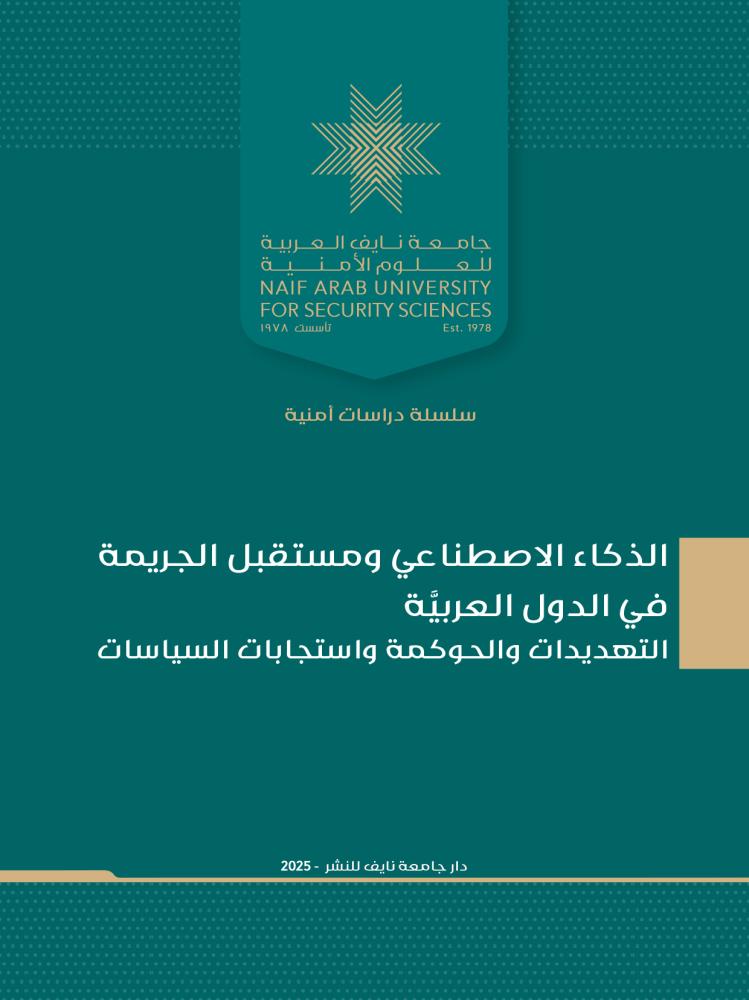


Category: Security Studies, Criminology, Artificial Intelligence
Publication Year: 2026
Language: Arabic
Publisher: Naif University Press
Author(s): Betania Allo, Mohamed El-Guindy, Taqwa Alhaj
The study indicates that the rapid advancement of artificial intelligence technologies has brought about a fundamental transformation in the security landscape of the Arab region. These technologies have effectively become a double-edged sword: on the one hand, they enable organized criminal networks to carry out sophisticated cyber-enabled fraud schemes and attacks through deepfakes and voice cloning; on the other hand, they enhance the capabilities of law enforcement and security agencies in analysis, predictive assessment, and the examination of digital forensic evidence. The study further reveals that the limited representation of the Arabic language in deepfake datasets renders the region more vulnerable to targeted voice fraud attacks.
To address this gap, the study developed an Arabic model based on RawNet2, trained on more than 44,000 audio samples. The model achieved a high detection accuracy of 99.25% in identifying deepfakes, representing a significant step toward building sovereign Arab capabilities in the field of digital security.
The study also proposes a four-dimensional roadmap to address future risks:
• Legislative dimension: Advocating for the development of unified Arab legislation on artificial intelligence based on a risk assessment approach, updating digital evidence frameworks, and criminalizing malicious synthetic content.
• Institutional dimension: Establishing national media verification centers and an Arab observatory to monitor and track AI-related threats.
• Technical dimension: Investing in defensive artificial intelligence, developing Arabic-language tools for deepfake detection, and strengthening the authentication of official content through digital watermarking technologies.
• Societal dimension: Enhancing citizens’ digital resilience and awareness, and mandating platforms to clearly label synthetic content.
The study concludes that addressing AI-enabled crime requires a comprehensive governance framework that balances innovation with security considerations. This can be achieved through close cooperation between governments, the private sector, and research institutions to ensure a secure digital future for Arab States.
ISBN:978-603-06-3129-2
Dimensions: 23 * 0.7 * 16 cm
Weight: 429 grams
Pages: 124